

At Turner Drake & Partners, the Economic Intelligence Unit spends much of its time modelling uncertain things: population growth, housing demand, market absorption, financial feasibility, and economic change. So, we applied the same instincts to another uncertain system: the 2026 FIFA World Cup.
The model combined four indicators of team strength: Elo ratings, FIFA rankings, squad market values, and recent form. We added effects for distance travelled by each team for games, climate familiarity, and host advantages. Then, lastly, we accounted for last minute squad updates resulting from injuries and our assessment of team morale and chemistry. We translated the resulting strength scores into expected goals and match probabilities. Those outputs produced projected group tables and a full knockout bracket.
How did the model perform?
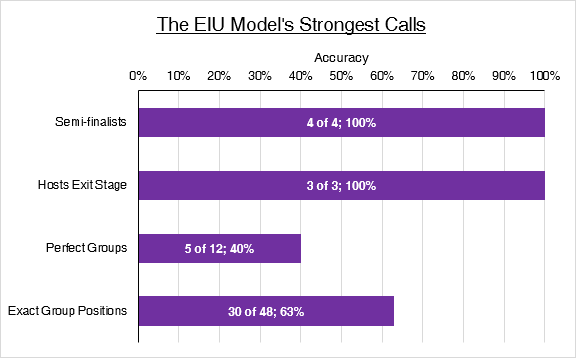
The model correctly predicted 30 of the 48 teams’ exact group-stage finishing positions, including five of the twelve groups in perfect order.
It also predicted that all three host nations would exit in the Round of 16 and correctly identified the exact four semi-finalists: France, Spain, England, and Argentina. This was the standout. In a 48-team tournament, getting all four semi-finalists right means the model understood the tournament’s broad hierarchy extremely well, even if it did not ultimately pick the correct champion.
Group stage
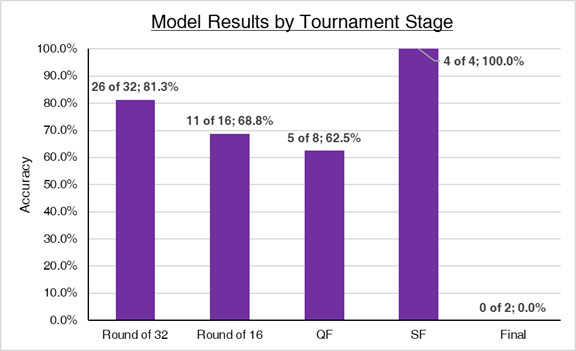
The model placed 30 of 48 teams exactly and perfectly ordered five groups. It was particularly good at separating the clear contenders from the weaker sides, although it missed several surprise qualifiers, including South Africa, Paraguay, Ghana, DR Congo, Sweden, and Cape Verde.
Round of 32
It projected 26 of the 32 teams that actually reached the first knockout round; an 81.3% hit rate. This was strong enough to preserve much of the tournament’s overall structure.
Round of 16
It projected 11 of the 16 teams that actually reached this stage. The bracket began to diverge because several earlier misses changed the actual matchups. Still, the model correctly called the elimination stage of Canada (unfortunately), Mexico, and the United States.
Quarterfinals
Five of the eight actual quarterfinalists were in the projected field. The three misses were Morocco, Norway, and Switzerland, while Brazil, the Netherlands, and Portugal were carried too far.
Semifinals
A perfect four out of four: France, Spain, England, and Argentina.
Final
This is where the model broke down. It projected France against England, with France winning. Spain instead beat Argentina. The model had ranked Spain second overall and identified it as France’s most credible alternative, but it chose the wrong winners in both semifinals.
What went wrong?
First, the model was better at structure than at shocks. Its broad ranking of teams was strong, but a deterministic bracket compounds every earlier error. Once one surprise changes a group position, every downstream matchup can change with it.
Second, it likely placed too much faith in baseline strength. Elo, FIFA ranking, market value, and recent form are useful, but they do not fully capture tactical matchups, suspensions, or a team improving rapidly during the tournament. Norway and Morocco were the clearest examples of teams whose tournament performance exceeded their initial path through the model.
Third, elite knockout matches are often close to coin flips. The model correctly found the four best-performing semi-finalists, but then selected the wrong winner in both semifinals. That is less a failure to identify quality than a reminder that small probability differences do not create certainty.
Why this felt familiar to an economic modeller
For us at TDP’s EIU, the subject matter changes, but the modelling discipline does not. Population, housing, financial, and economic models also begin with incomplete information. We select variables, define relationships, make transparent assumptions, and test whether the resulting outputs are plausible.
The World Cup model behaved much like an economic forecast in which it captured the overall structure very well, identified the leading outcomes, and then missed the precise sequence of events at the end. That is why models are best understood as decision-support tools, and not crystal balls. After all, God created economists so weather forecasters could look good.
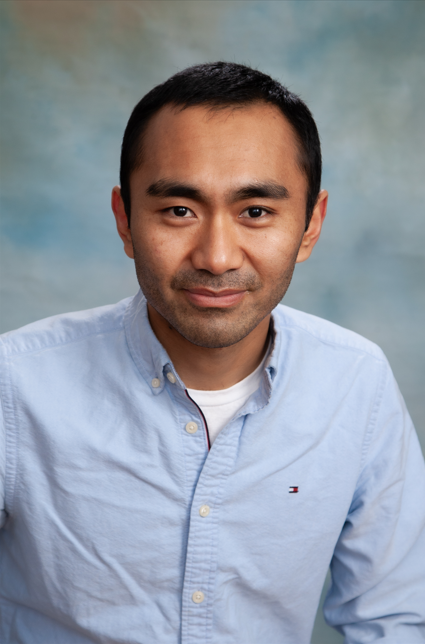
Jigme Choerab is manager of our Economic Intelligence Unit. For more information about how you can benefit from the unique expertise of our Planning & Economic Intelligence team, contact Jigme at (902) 429-1811 or .